
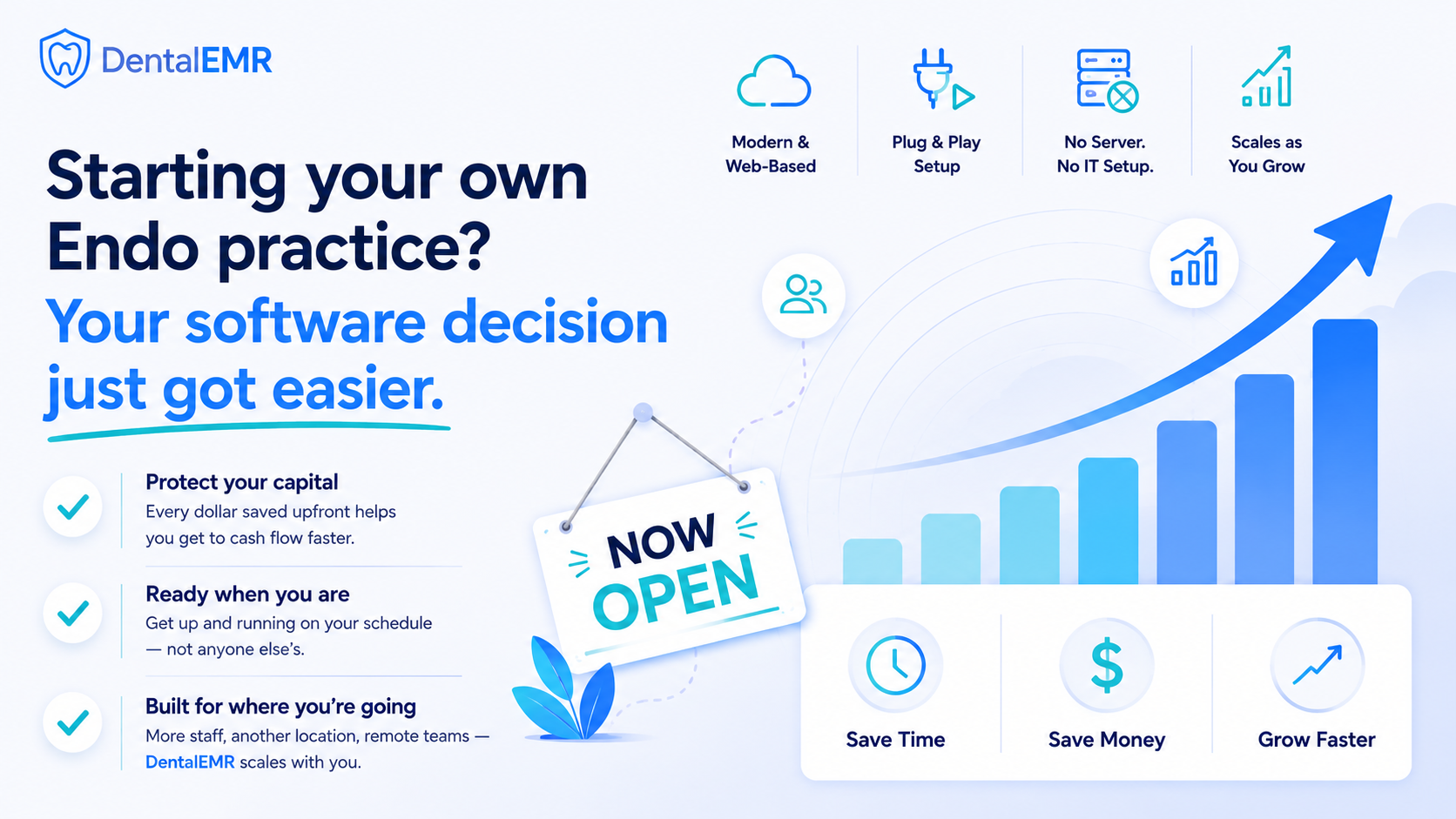
Starting an Endodontic practice is one of the most demanding things you can take on professionally. The decisions come fast, they overlap, and most of them carry real capital and logistical weight. Space build-out, equipment, imaging, staffing, credentialing, billing setup, patient communication tools. The list is long and the timeline is unforgiving.
Practice management software tends to land somewhere in the middle of that list. It does not feel like the most urgent purchase in the early stages, but it shapes how every other system in your practice connects and functions from day one. Getting it right early matters more than most startup Endodontists expect.
The most common mistake startup Endodontists make with practice management software is waiting too long to choose it. The reasoning makes sense in the moment: there are larger, more tangible decisions in front of you, and software seems like something you can figure out once you are closer to opening.
By the time you are ready to make the call, you are under pressure to just pick something and move forward. That pressure leads to two common outcomes. The first is defaulting to whatever software you trained under as an associate, whether or not it was built for Endodontics specifically or fits how you want to run your practice. The second is choosing based on a recommendation from a colleague without evaluating whether it fits your setup, your growth plans, or how your staff will actually use it.
Both can work, but they are reactive. And reactive software decisions tend to create migration costs later that a more deliberate early choice could have prevented.
Not all practice management software is built for specialist practices. General dentistry platforms adapted for Endo often require workarounds for specialty-specific documentation, referral tracking, CBCT integration, and reporting. Those workarounds add friction for your staff over time and create gaps in your data that become harder to address the longer you wait. They also mean you are paying for a significant amount you will never use: recare scheduling, hygiene and prophylaxis workflows, and other general dentistry features that have no place in an Endodontic practice.
Beyond the wasted spend, there is a product development reality worth understanding. General dentistry platforms are investing their resources across a wide range of workflows and feature requests from general practices. Endo-specific needs are not the priority. If you want a platform that is actively reinvesting your subscription into the workflows your practice actually runs, you need software built exclusively for Endodontists.
What most startup Endodontists miss is that the software selection is not just a technology decision. It is an operational decision. The platform you choose shapes how your team documents, how referrals are tracked, how imaging is accessed, how patients are billed, and how you measure the health of your practice. Making that decision well means thinking past the demo and asking how this system will perform when you are busy, when you are adding staff, and when you are ready to grow.
The other thing startup practices miss is the infrastructure question. Many practice management systems require a local server, IT configuration, and upfront hardware investment before you can go live. For a practice that is still building out its physical space, that is one more coordination point in an already full project plan. Web-based platforms eliminate that entirely.
DentalEMR was built exclusively for Endodontists. That means the clinical documentation, referral tools, imaging workflows, and reporting were designed around how Endodontic practices actually operate, not adapted from a general dentistry platform.
For startup practices specifically:
DentalEMR also integrates directly with your imaging, your referral portal, merchant services through Blue Swipe, and your patient communication workflows. Everything runs in one platform from the beginning, which matters when your team is small and every system that requires separate management adds real time cost.
The reason practice management software is more consequential in the startup phase than most Endodontists expect is that it is far easier to build good habits and workflows around a system that fits than it is to retrain an established team after the fact.
When a practice launches with software matched to its specialty and its growth plan, the team builds from a foundation that supports them. Documentation is consistent from the first chart. Referral tracking works from the first case. Reporting gives you real, comparable data from the beginning rather than gaps and workarounds you have to account for when you are trying to understand your practice's performance.
Migration is always more disruptive than making a deliberate choice early. The data moves, but the habits do not. Retraining an established team on a new platform carries operational and morale costs that most startup Endodontists, with the benefit of hindsight, would have gladly avoided.
If you are in the planning phase, before you have opened or are close to your opening date, the software decision is one you can make once and not revisit. That is rare in a startup year.
The most important factors for a startup are specialty-specific clinical documentation that does not require workarounds for Endo, no server infrastructure requirement so you can go live quickly and without additional capital outlay, and a platform that scales as you add staff and locations. Support responsiveness also matters significantly in the early phase when your team is still learning the system and there is no experienced staff to troubleshoot internally.
No. DentalEMR is web-based and does not require a local server or an IT implementation day. Startup Endodontists can be operational in DentalEMR quickly, which means less time configuring software during an already demanding launch period.
DentalEMR is built to scale. Adding staff, locations, or remote team members does not require migrating to a new platform. The system that supports your first patient is the same system that supports a multi-location practice.
Yes. Because DentalEMR is web-based, you can begin setting up your system, building out your templates and workflows, and training staff before your physical space is complete. There is no server to install on site and no hardware to configure before you can access the platform.
DentalEMR was built exclusively for Endodontists, not adapted from a general dentistry platform. The clinical documentation, referral tracking, imaging integration, and reporting reflect how Endodontic practices actually operate. General dentistry platforms used in Endo settings typically require workarounds for specialty-specific workflows, and those workarounds accumulate over time into real friction for your team.
Yes, with an important distinction. Intraoral radiographs are managed directly within DentalEMR alongside your clinical documentation, referral portal, and billing. For CBCT, DentalEMR bridges to your existing CBCT software so you can access your scans without leaving your workflow, while your CBCT software continues to manage and store those files. You get the connectivity without any change to how your 3D imaging is handled.
The best way to get an accurate quote is to connect with one of our team members so we can account for your specific practice setup and customizations. DentalEMR is built to be affordable, all-inclusive, and accessible from day one, with a startup-friendly structure that keeps your upfront costs low so your capital goes toward what matters most in your first year.