
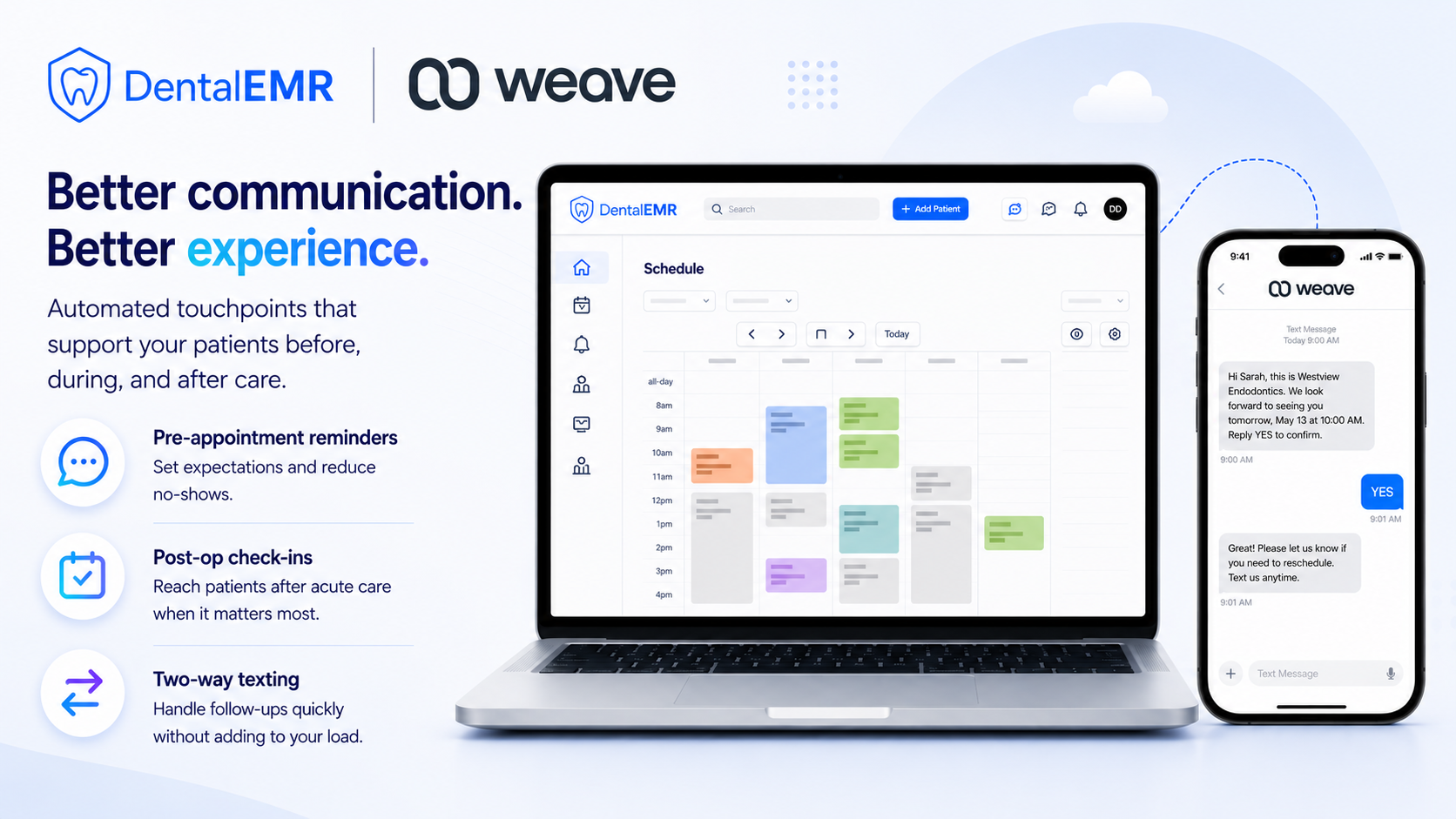
Endodontic patients are not like other dental patients. They arrive anxious, often in pain, and with very little context for what is about to happen. The appointment itself may go smoothly, but the communication before and after it shapes how the patient remembers their experience, and that memory travels. It gets back to the GP who referred them, to their family members, and occasionally to the internet.
Most practice management platforms treat patient communication as a checkbox feature. Send a reminder, maybe a recall message, done. For Endodontic practices specifically, that approach leaves a meaningful gap. DentalEMR's integration with Weave closes it with automated workflows built around how Endodontic care actually works.
Walk into any Endodontic practice and you will find a version of the same challenge: front desk staff managing appointment reminders manually, post-op check-ins that depend on someone remembering to make the call, and patient communication that looks no different from what the general dentist down the street sends.
The problem is not effort. It is infrastructure. Most communication platforms were built for general dentistry and scaled outward toward specialties. The defaults do not match Endodontic procedures, appointment cadences, or the emotional state of patients presenting for acute care. A patient being seen for a root canal needs different messaging than a patient coming in for a cleaning. The preparation, the timing, the tone. All of it is different.
When communication is generic, it either gets ignored or it creates confusion. Neither outcome helps your practice or the patient experience you are trying to deliver.
There is a direct line between patient communication and referral volume that most Endodontists underestimate. When a referring GP sends a patient to your practice, they are making a professional commitment. They are trusting that their patient will be treated well and that the Endodontist they chose will reflect well on them.
The patient's experience does not stay with the patient. They report back. They mention how the appointment went, whether anyone followed up, whether they felt informed or left in the dark after the procedure, and whether they felt comfortable throughout the entire experience. That comfort piece is significant. When a patient feels at ease from the first communication through the post-op follow-up, they form an emotional attachment to the experience. That is when they become advocates. They talk to their family, they mention it to their GP, and they remember the Endodontist by name. The GP hears this, often indirectly, and it factors into how confidently they refer again.
A patient who received a clear pre-appointment message, a timely post-op check-in, and easy access to two-way communication with the practice is going to have a very different story to tell than one who received a generic reminder and nothing afterward. That difference is not clinical. It is operational. It is intentional.
DentalEMR's integration with Weave brings Endodontic-specific communication workflows directly into your practice management system. Here is what that looks like in practice:
Baked in with DentalEMR's integrated intake process, the patient is well-informed of your practice and level of service long before they walk in the door. That first impression starts the moment they receive their first communication, not the moment they sit in the chair.
The key distinction is that these workflows were built around Endodontic appointment types, not adapted from a general dentistry template. The timing, the triggers, and the messaging logic reflect how Endo practices actually operate, so you maximize your Endodontic functionality while staying within a system built to accommodate your practice's needs and budget.
Patient communication in Endodontics is not just a patient satisfaction strategy. It is a referral strategy, a retention strategy, and increasingly, a reputation management strategy.
Endodontists who send well-timed, relevant communication consistently report that patients comment on it unprompted. The post-op check-in that arrives the evening after a root canal is the kind of detail that patients share with their GP at their next restorative appointment. The referring dentist hears, "They actually followed up to see how I was doing." That is not a small thing.
For practices managing multiple referring relationships, the compounding effect is significant. Every positive report from a shared patient is a reinforcement of the referral decision the GP made. Over months and years, that consistency becomes a competitive differentiator that is very difficult for a competing practice to replicate without the right infrastructure in place.
Weave serves a wide range of industries and dental specialties. What makes DentalEMR's Weave integration distinct is the Endodontic-specific workflows built around how Endo practices operate. The integration reflects appointment types, procedure timing, and patient communication needs that are specific to Endodontics rather than generic dental defaults.
No. The automated sequences run based on appointment triggers in DentalEMR. Your staff sets the workflows up once, and the system handles routine communication from there. Staff involvement is reserved for conversations that require a personal response.
Two-way text is included. Patients can respond to automated messages and reach your front desk directly via text, and those conversations are managed through the same Weave interface your staff is already using.
Follow-up sequences can be configured within the workflow logic. The system can send a second reminder at a different time or through a different channel without requiring staff to manually identify and follow up with non-responders.
Weave connects directly to DentalEMR. Appointment data, patient contact information, and communication history sync between the two platforms. There is no separate login and no manual data entry required to keep both systems current.
Get started with Weave