Several practice management software platforms built on server-based architecture have recently announced sunsetting their support services. For Endodontists still running on these systems, the announcement may have felt like a routine service update. It is not. A company announcing sunsetting support for an on-prem practice management platform is typically signaling something larger: that it has stopped investing in the product. Understanding what that means, and what to do about it before the situation becomes urgent, is one of the more consequential decisions your practice will make this year.
When a software company sunsets support, the visible change is that the help desk becomes harder to reach. Some vendors are now offering continued support as a premium add-on, billing practices for something they previously expected to be included. Others are winding it down entirely, leaving practices with a system that still runs but has no safety net when something breaks.
What most practices do not immediately register is that sunsetting support is rarely an isolated decision. It is a business signal. Companies do not stop investing in customer support while continuing to invest in product development. When the support window closes, so does the technology roadmap. No new features. No meaningful platform updates. The software becomes frozen in time, and your practice runs inside it.
The larger issue is timing. Sunsetting support is almost always a precursor to discontinuing the product altogether. Vendors follow a predictable pattern: first they reduce investment in support, then they announce an end-of-life date for the software itself. Practices that wait until that second announcement to start evaluating alternatives will have significantly less time and fewer options to make a clean transition.
AI is also putting meaningful pressure on server-based software in ways that compound this problem. This is not about what is possible. On-prem systems can connect to certain AI capabilities through APIs. It is about what is sustainable long-term. The AI tools reshaping practice management are increasingly being built for web-based infrastructure because of its ability to scale without the constraints a physical server creates. On-prem systems will continue to create barriers that cloud-based platforms simply do not have, and AI investment will follow the path of least resistance. The gap between what each can sustainably support will only widen over time.
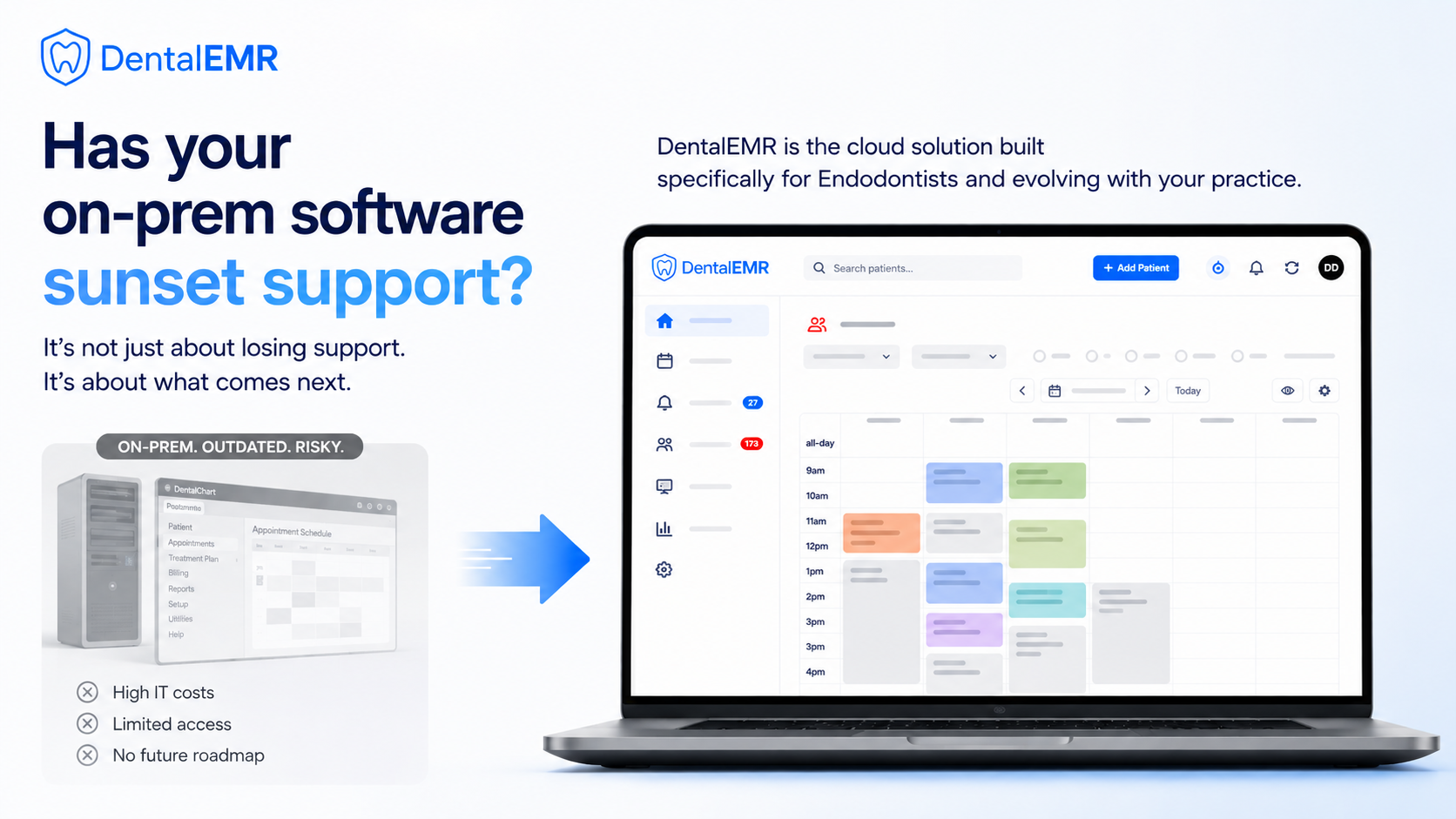
DentalEMR was built specifically for Endodontists and continues to evolve as the specialty does. The migration process from a legacy system is handled by DentalEMR's team, not the practice:
The goal is that you arrive on the other side with continuity of care and a team that is ready to run the practice from day one.
Referral relationships are built on responsiveness. When a referring GP sends a patient to your practice, they expect timely updates, accessible reports, and communication that reflects well on their professionalism. An aging, unsupported platform limits what you can deliver. Automated referral reporting, digital forms, and patient communication tools are increasingly table stakes for Endodontists who want to build and maintain strong referring relationships.
Staying on a platform with sunsetting support also affects your team. Staff adapt their workflows to work around the limitations of aging software. Manual steps get added where automation should exist. Efficiency erodes quietly, and the cost shows up in time rather than in a line item, which makes it easy to overlook.
Check your vendor's communications from the past 12 months, including emails, in-app notifications, and their support documentation. If you received any notice about changes to support tiers or end-of-support dates, that is your signal. If you are unsure, contact your vendor directly and ask about the product roadmap and support timeline going forward.
Data ownership and export rights vary by vendor contract. Some platforms provide clean data exports in standard formats. Others use proprietary formats or charge fees for data retrieval. It is worth reviewing your contract now, before a discontinuation is announced, to understand what your rights are and what the export process looks like.
It helps to think about two parts separately: the data migration and the team onboarding. Data migration typically takes just a couple of days. Getting your team fully up and running in their workflows usually takes a couple of weeks, and that timeline moves at whatever pace works for your practice. There is no IT installation required, which means we can get started quickly. In our fastest onboarding, a practice was fully operational in as little as two weeks. We adapt the process to what makes the most sense for you.
In most cases, yes. DentalEMR's migration team works directly with the legacy system to extract and transfer patient records, treatment history, and clinical notes. The process varies depending on the source system, but preserving continuity of care records is a priority in every migration.
It can feel like there is never a good time. There is always something in the schedule, a busy stretch, a staffing change, a goal you are trying to hit first. Readiness is less about timing and more about having the right support around the transition. Chat with our team about your specific situation and we will help you plan the process so you do not have to figure it out on your own. Our job is to be your concierge through the transition, not to hand you instructions and wish you luck.