When a new team member joins your Endodontic practice, the first instinct is to get them productive as quickly as possible. That is a reasonable instinct. But it is not the whole picture.
The way your practice onboards a new hire shapes more than how fast they learn the system. It shapes whether they feel confident in their role. Whether they feel supported when questions come up. And ultimately, whether they stay. Practices that treat onboarding as a ramp-up problem get a certain result. Practices that treat it as a foundation-building investment get a different one.
Staffing is the top business concern for sixty-two percent of dentists, according to ADA Health Policy Institute data. And the cost of turnover in a dental practice adds up quickly. Gallup estimates that replacing a team member typically costs between half and two times their annual salary, once you account for recruiting time, lost productivity during the vacancy, and the weeks it takes a new person to reach full competency.
For a specialty practice where every role, from the front desk coordinator to the clinical assistant, touches patient experience and daily production, that cost is not abstract. It compounds with every departure.
The filling of a seat is just the beginning. What happens in the weeks after someone starts, how well they learn the system, how supported they feel when they hit their first hard question, whether they can find answers without derailing a senior team member, determines whether that hire works out long term or adds to the turnover cycle.
The instinct in most practices is to frame onboarding around one question: how quickly can this person start contributing? That is understandable when your team is already at full capacity and daily production is on the line.
But speed and success are not the same thing. A team member who was rushed through onboarding and is technically functional may still feel unsure of themselves in patient-facing situations. They may hesitate on billing questions they have not fully worked through yet. They may be reluctant to ask for help because they do not want to appear behind. These are not performance problems. They are onboarding problems.
The research on employee retention is consistent on this point: people who feel genuinely set up to succeed in their role are significantly more likely to stay in it. That means having access to resources when questions come up, not just during week one. It means knowing there is somewhere to turn that is not a coworker who is already stretched. For an Endodontic practice managing persistent staffing pressure, structured onboarding is not just a faster ramp. It is a retention strategy.
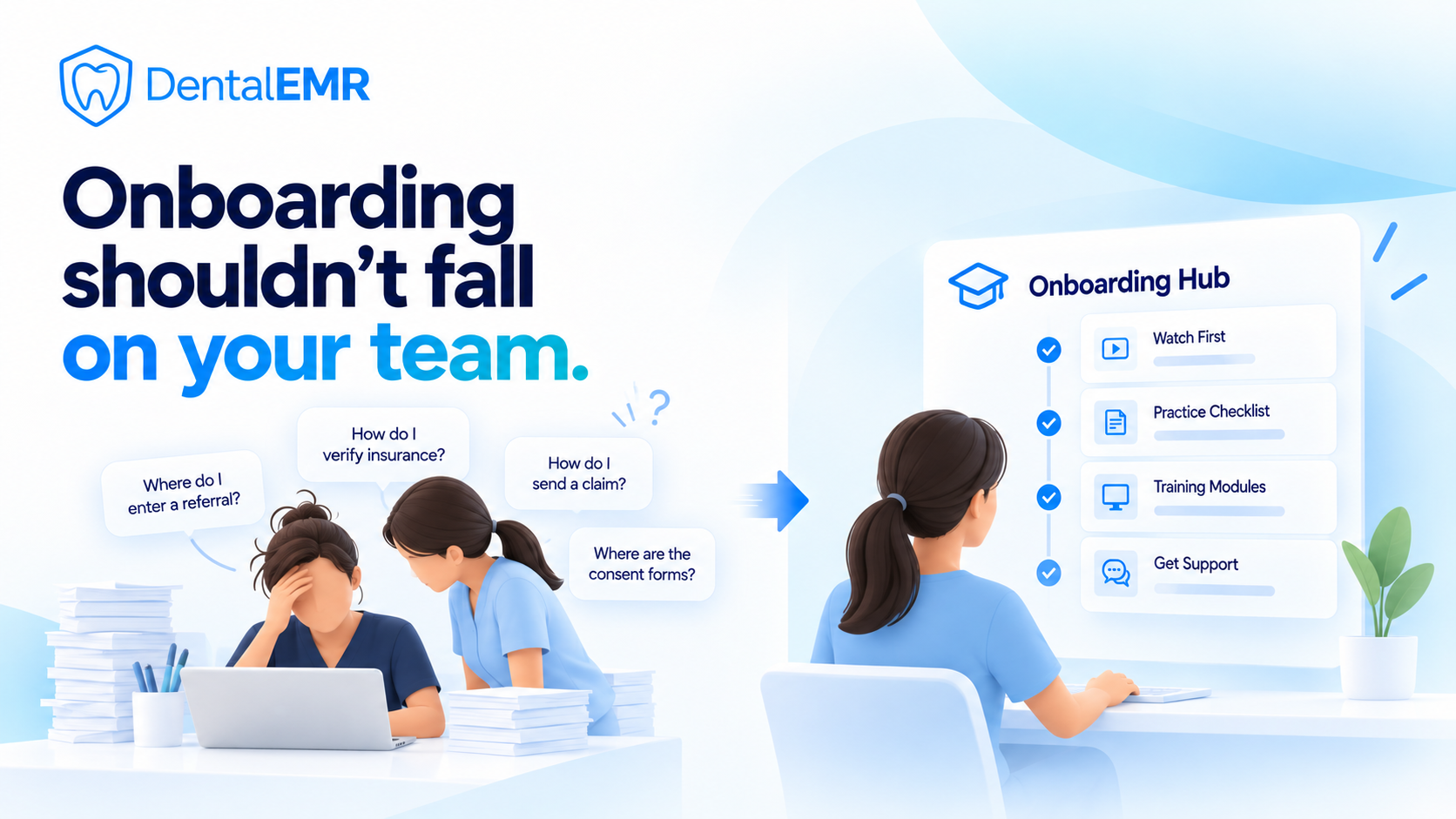
DentalEMR's onboarding system is built around one idea: every new team member deserves a clear path, not just an introduction.
When a new hire joins a practice on DentalEMR, they log in and find a structured learning environment built around how Endodontic practices actually run. Not a generic tutorial that could apply to any dental software. Not a binder of screenshots to work through on their own. A learning path designed for the workflows they will be doing from day one, whether that is scheduling, referral coordination, billing, or insurance.
The DentalEMR Academy gives new team members on-demand access to step-by-step articles and how-to videos covering the full scope of their role. They can move through the material at their own pace, revisit topics as their responsibilities expand, and come back to anything they need to clarify later. The learning does not stop after week one.
When questions come up beyond what the Academy covers, the DentalEMR support team is there. Your new hire has someone to contact who understands Endodontic practice workflows specifically, not a general support queue where the person on the other end has never seen an Endo clinical record or a referral completion workflow. The question lands with someone who has context. And it does not have to land on the coordinator sitting next to them.
Your experienced team stays in their lane. Your new hire builds competency on a structure, not through osmosis. The transition window is shorter because the learning is not bottlenecked by human availability.
This is the part of the onboarding conversation that tends to get left out.
Practices that invest in structured onboarding are not just getting new hires functional faster. They are reducing the conditions that drive early turnover. A team member who feels confident in their role, and knows how to find help when they need it, is less likely to leave in the first six months, which is when departure risk is highest.
The effect compounds over time. An Endodontic practice with a reliable onboarding process is a more resilient practice. When a role turns over again, and in a high-turnover environment it is a matter of when, not if, you are not starting from scratch. The same system that supported the last person is ready for the next one.
For the team members who have been there longest, it also changes the daily experience. When a new hire has a clear learning path and a support team behind them, your experienced staff are not pulled into informal training every time someone new starts. They do the work only they can do. That is better for morale, better for patient experience, and better for retention across the board.
DentalEMR also does not rely on your office manager to cascade product updates to the team. When the platform ships new functionality or workflow improvements, every user sees it directly. That means a clinical assistant is not missing an enhancement because it got filtered through a busy coordinator. Everyone stays current. Everyone can implement changes that make their day easier. The investment in setting people up to succeed does not stop at ninety days. It runs as long as they are with the practice.
Does DentalEMR's onboarding support cover all roles in the practice, or just front desk?
The DentalEMR Academy and support team cover workflows across the full practice, including scheduling, referral coordination, billing, insurance, and clinical documentation. Every team member has access to a learning path relevant to their role, not a one-size tutorial that assumes everyone has the same responsibilities.
How long does it take a new hire to get comfortable in DentalEMR?
Most new team members are functional in their primary workflows within a few days. The structured onboarding path and on-demand Academy resources mean the ramp-up timeline is not dependent on a senior team member being available to answer every question as it comes up.
What if a new hire has never worked in an Endodontic practice before?
DentalEMR is built exclusively for Endodontists, which means the onboarding system reflects how Endodontic practices actually operate. A team member coming from general dentistry or a non-dental background starts on a foundation built for this specialty, not a general platform adapted for Endo.
Does the DentalEMR support team understand Endodontic workflows specifically?
Yes. The support team is trained on Endodontic practice management, not dental software generically. When a new hire has a question about referral tracking, claim submissions, or how to find a specific report, the support team understands the context behind that question.
How does structured onboarding affect staff retention?
Employees who feel well-supported in their first weeks and months are more likely to stay in their role longer. Access to structured learning resources, on-demand help, and a clear path through the learning curve reduces the friction that typically drives early departure. Good onboarding is not just a faster ramp. It is an investment in keeping the people you hired.