Every Endodontic practice has a few. The extra step before a claim goes out. The second place a referral gets noted so nothing slips. The sticky note on a monitor that tells a new hire what the software won't. None of it feels like a problem on any given day, which is exactly why it adds up. If your Endodontic practice management software wasn't built for how your practice operates, your team is quietly making up the difference, and so is your bottom line.
When a system doesn't fit the way your practice runs, the team adapts. That is what good teams do. They find a path that works, they teach it to the next person, and within a few months nobody remembers it was ever a workaround. It is just how things get done here.
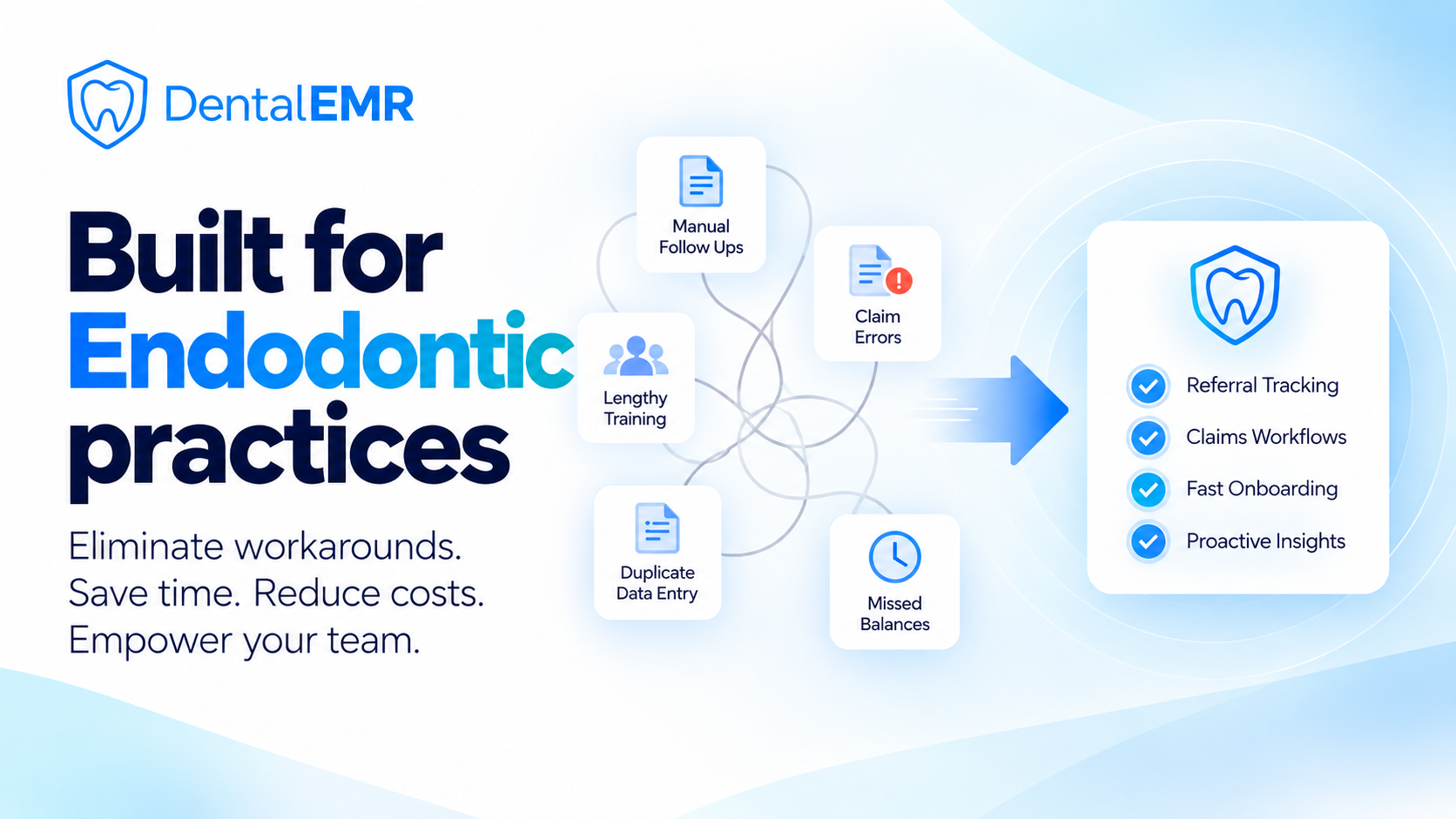
The trouble is that the cost doesn't disappear when the habit becomes normal. It moves. It shows up as minutes added to tasks that should take seconds, as the same information entered in more than one place, as a front desk coordinator who is carrying more of the practice in their head than any system should ask of them. Multiply that across a week, a quarter, a year, and across every person on your team. Your practice is leaking efficiency through time, through cost, and through staff frustration that is hard to name until it is already affecting the people doing the work.
Most practices don't stay on software that frustrates them because they think it is great. They stay because the pain is spread thin. Looking at any one workaround on its own, it is easy to feel like it isn't bad enough to justify a switch, so the decision keeps getting pushed to a quieter month that rarely arrives. But the workarounds don't live on their own. Added together, they are one very large cost.
The workarounds also limit what you can see. When referral information, claims status, and balances live in different places, you find out about problems after they have already grown. An outstanding balance becomes an aged balance. A claim that needed one correction becomes a denial and a resubmission. A referring office that is sending fewer cases doesn't show up until the quarter is over.
Your team isn't failing. They are covering for a tool that could be doing more of the work.
DentalEMR is built exclusively for Endodontic practices, so the workflows start from how an Endo practice actually runs instead of being adapted from somewhere else. A few places where that changes the day:
The efficiency is real, but it isn't the whole story. A team that isn't spending its energy on workarounds has more of itself left for the work only your people can do: the conversation with a nervous patient, the call that keeps a referring dentist confident in your practice, the follow-up that makes someone feel looked after.
Those moments are where referral relationships are built. Patients feel a practice that runs smoothly behind the scenes, and so do referring offices. Your staff, who have been quietly absorbing the gaps, feel it most of all: less stretched, more confident, and more likely to stay.
Workarounds are the extra steps, duplicate entries, and manual checks a team adds to cover something their practice management software doesn't handle well. Sometimes the software handles a task poorly. Sometimes it doesn't handle it at all. Some Endodontic software has no referral portal or referral management at all, even though referrals are the core of an Endo business model, which means the team has to build a system outside the software just to make it happen.
Ask your team. Ask what frustrates them most, what bogs them down, and which manual processes they feel could be automated. Your team sees the gaps every day, and a busy practice rarely has anyone with the time to watch for them from the outside. Including your staff in the conversation also builds buy-in. When your team knows their voice shapes how the practice grows, they are more invested in its long-term success.
Endodontic practices run on referral relationships rather than long-term recall patients. Software designed around that model treats referral tracking, letters, and reporting as core functions, so you don't have to build a separate system to follow them.
You can have access to DentalEMR in as little as one business day. Data transfers are completed within a couple of business days. Onboarding your team can take as little as two weeks, or as long as you need, depending on your team's capacity and how busy your practice is. We adapt to your needs to make sure it is the right fit.
If you are waiting for the right time, it is never going to come. It comes down to your goals. Look at your three-month, six-month, and twelve-month goals, and if a new system is an opportunity to grow your practice, any time is the right time to start evaluating. That might be to get a head start on the new year or on a busy summer. There is always a good opportunity to look at what you are doing and see if there is a better way to handle it with the most modern tools.