If you search for the best EMR software for Endodontists, you will find articles recommending platforms built primarily for general dentistry. They will include one or two items that apply to your specialty and describe the rest in vague terms like "flexible" and "customizable." Most of that software was not designed with Endodontics in mind, and that gap shows up in your day-to-day workflows in ways that are easy to miss until you are already stuck with the wrong system.
This guide is not a ranking. It is a breakdown of what makes practice management software a genuine fit for an Endodontic practice, and what gets left out when the software was built for someone else.
General dentistry is built around long-term patient relationships. Software built for general dentists is optimized for recare, treatment plan tracking across multiple visits, and patient retention over years. The KPIs that drive general dental software development (recall rates, patient lifetime value, hygiene productivity) have almost nothing to do with how an Endodontic practice measures success.
Endodontics runs on referrals. The patient in your chair is usually someone else's patient, referred to you for a specific procedure. Your success depends on how well you communicate with the general dentist who sent them, how fast you deliver the completed report, and whether the referring dentist feels confident that their patient was in good hands. When your software was built to optimize for something else entirely, those workflows get treated as secondary. They get added on as integrations or workarounds rather than designed as core features. That is where the friction starts.
The surface-level checklist looks the same across almost every platform. Can it schedule appointments? Yes. Can it handle billing? Yes. Does it store patient records and imaging? Yes. Most platforms pass that test, which is why selecting software based on that checklist alone does not reveal the problems until you are already in the middle of onboarding.
The questions that actually differentiate platforms are harder to see in a demo. How does referral tracking work: is it a native feature or a third-party add-on? When a procedure is complete, what does the report delivery workflow look like, and how many steps does it take for a referring GP to access that report without calling your office? If you have patients at two locations, can your billing team access both from one login? These are Endodontic practice management questions. Most general dental software gives vague answers to them because the workflows were never fully built out.
When you are evaluating your options, these are the capabilities that separate a platform built for Endodontists from one that was adapted for them:
The clinical record is the starting point, not the end goal. What your practice management software enables beyond documentation is what determines whether your practice grows.
Every completed referral is an opportunity to strengthen or weaken a relationship with a referring general dentist. When reports are delivered fast and without friction, that GP does not have to chase you down to find out if their patient's treatment is complete. Their restorative treatment plan can move forward. Their patient had a good experience. That is the kind of follow-through that builds a referral relationship over time, and it happens at the system level, not just because of how good your clinical work is.
For startup Endodontic practices, the stakes are even higher. The workflows you put in place before your first patient become the habits your team builds on. A system that was not built for your specialty forces workarounds early, and those workarounds compound as your case volume grows. The practices that build on the right foundation in year one are the ones that can scale in year two without changing everything.
Is general dental software good enough for an Endodontic practice?General dental software can handle basic scheduling, charting, and billing for an Endodontic practice, but the features that matter most to Endodontists (referral tracking, GP portal access, report delivery workflows, and Endo-specific clinical documentation) are typically not fully built out. Practices on general dental software often manage these workflows through workarounds that take more time than they should.
What does cloud-based practice management software actually mean for an Endodontic practice?Cloud-based means your practice data is hosted securely off-site and accessible from any device with a browser. For Endodontists, this means no physical server in your back office, no IT infrastructure to maintain, and the ability for your billing team and clinical staff to access patient records from wherever they work. It also means updates and security patches happen automatically without requiring a service call.
What should I look for in referral tracking software for Endodontists?Referral tracking for an Endodontic practice should be native to the practice management system, not a separate add-on. It should allow you to see which general dentists are referring patients, track the status of each referred case, and give the referring GP access to the completed report without requiring your staff to send it manually. The cleaner that workflow, the stronger your referral relationships.
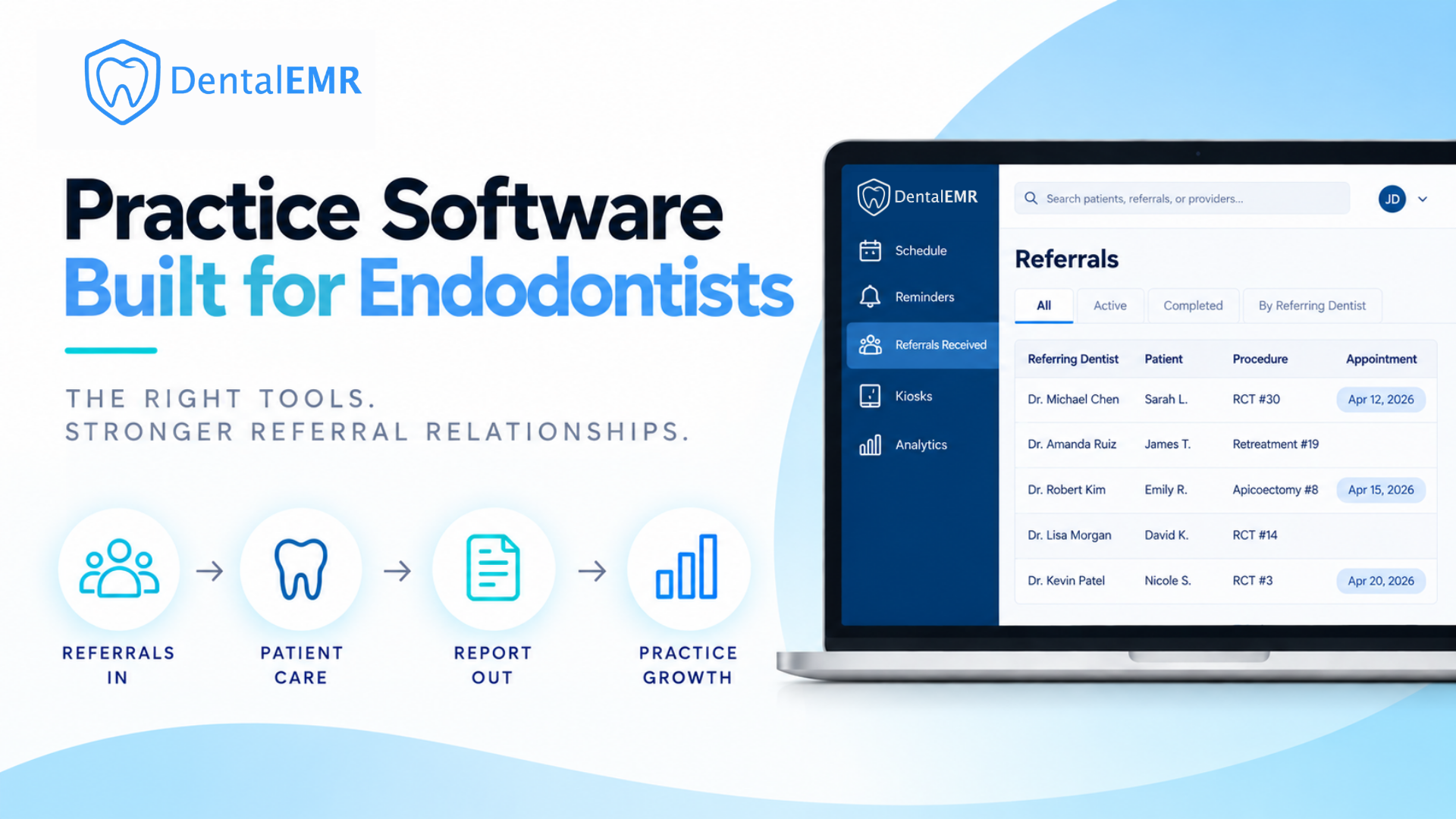
How does DentalEMR differ from general dental software?DentalEMR was built exclusively for Endodontists. That means referral tracking, GP portal access, report delivery, and Endo-specific billing and documentation are core features, not afterthoughts. There is no general dentistry feature set to work around, and every update to the platform is focused on the workflows that matter to Endodontic practices specifically.
What happens to my patient data if I switch software?Your patient data belongs to your practice, not your software vendor. Before committing to any platform, ask specifically how data export works: in what format, at what cost, and how long it takes. A vendor that makes that process difficult is using your data to discourage you from leaving. At DentalEMR, patient records are exportable in standard formats, and we will work with your team to make any transition straightforward.